


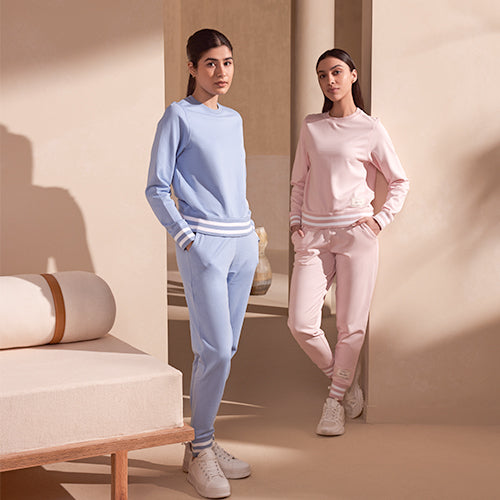
Side Panel Pants: The Quiet Engineering Behind ALONGE's Most Effortless Silhouette

There's a specific kind of frustration every woman knows. You find pants that look right — the colour, the length, the cut — and then you sit down. Or walk fast to catch a cab. Or reach up to grab something off a shelf. And suddenly the pants that looked perfect on the hanger are fighting you.
At ALONGE, we don't think you should have to choose between how pants look and how they let you live. That belief is the entire reason side panel pants exist in our line-up — and it's worth explaining why this particular design detail matters more than it seems to.
What a Side Panel Actually Does
A side panel isn't a styling flourish. It's a structural decision.
Traditional pants are built from a small number of large fabric pieces, stitched along straight seams. That construction works fine when you're standing still. But the human body isn't still, and it isn't straight — hips flare, thighs move, waists shift with every step and every seated hour at a desk.
Side panelling breaks the silhouette into more considered pieces, inserted along the sides of the leg and waist. This does two things at once:
- *It follows the body's natural lines* instead of forcing the body to follow the fabric's.
- *It creates built-in room for movement* — the seam itself becomes a hinge, flexing where you flex, without needing excess fabric bunched at the waist or hip to compensate.
The result is a pant that keeps its shape when you're standing in a meeting, and moves without protest when you're rushing across a platform to catch a train.
Where Movement Meets Fabric: The iCotton Advantage
Design alone can't deliver flow — the fabric has to move with it. This is where our side panel pants lean on iCotton, ALONGE's engineered cotton fabric that behaves less like traditional cotton and more like a performance textile, while remaining 100% cotton at its core.
Regular cotton is breathable but rigid — it creases, it resists stretch, and over time it can lose shape around the areas that see the most movement (typically the hips, seat, and knees). iCotton is engineered differently: it carries the softness associated with viscose, the give associated with lycra, and a subtle finish closer to polyester — without introducing the synthetic feel or the heat-trapping that comes with those fibres.
Paired with a side-panel cut, this means:
- The *panel provides the structural room* to move.
- The *fabric provides the give* to move without resistance.
Together, they solve the problem most pants only solve halfway. Stretch-only pants often move but lose their shape by evening. Structured pants hold shape but restrict movement. Side panel pants in iCotton are built to do both — hold their form through a 10-hour day, and still let you sit cross-legged in a client meeting without the fabric pulling at the seams.
Durability: Built for Repetition, Not Just a Photograph
A pant that flexes constantly is under more mechanical stress than one that doesn't — every panel seam is a point that will eventually weaken if the fabric or the construction can't handle repeated movement. This is a genuine engineering question, not a marketing one, and it's why durability had to be designed in rather than assumed.
iCotton's fibre structure is built to withstand this kind of repeated stress-and-release cycle without the fraying or thinning that regular cotton develops at high-movement zones. Combined with panel seams that are reinforced at the stress points — hips, inner thigh, waistband — the pants are engineered to hold their shape and structural integrity wash after wash, wear after wear, rather than softening into shapelessness the way many stretch cottons do within a few months.
In practical terms: these are pants meant to be worn often, not saved for occasions. That's a deliberate design philosophy at ALONGE — comfort-led luxury only means something if it survives real, repeated, everyday use.
Style: Structure That Still Reads as Effortless
The side panel is also, quietly, a styling tool. Because the panel can be tailored — tapered at the ankle, widened at the hip, contrasted in tone or texture — it gives a single silhouette a surprising amount of range:
- A *tapered side-panel pant* reads structured and polished — ideal for the office or a client meeting.
- A *wide-leg version* with the same panelling reads relaxed without looking undone — suited to travel days or weekend wear.
- Subtle panel detailing (a tonal seam, a slightly contrasting finish) adds visual interest without needing prints, embellishment, or anything that competes for attention.
This is consistent with how ALONGE thinks about design more broadly: minimal, clean silhouettes that look considered rather than loud. The panel does the work of making the pant interesting; nothing else needs to try too hard.
Built for Real Bodies, Not Just Ideal Ones
Perhaps the most important thing about side panel construction is what it does for fit across different body shapes. Because the panel is a separate, tailorable piece, it allows adjustment at the hip and thigh independent of the waist and leg line — which means the same pant can be cut to flatter a range of real body proportions, rather than assuming one idealised shape and expecting every body to conform to it.
This is the same principle behind ALONGE's broader design philosophy: clothing should adapt to the woman wearing it, not the other way around.
The Takeaway
Side panel pants are a small design decision with an outsized effect. They're the difference between pants you wear despite the discomfort and pants you forget you're wearing at all — because they move when you move, hold their shape when you need structure, and look considered without asking you to think about them twice.
That's the promise behind every ALONGE piece: luxury that moves with you, comfort that isn't negotiable, and design built for the life you actually live - not the one on a runway.